











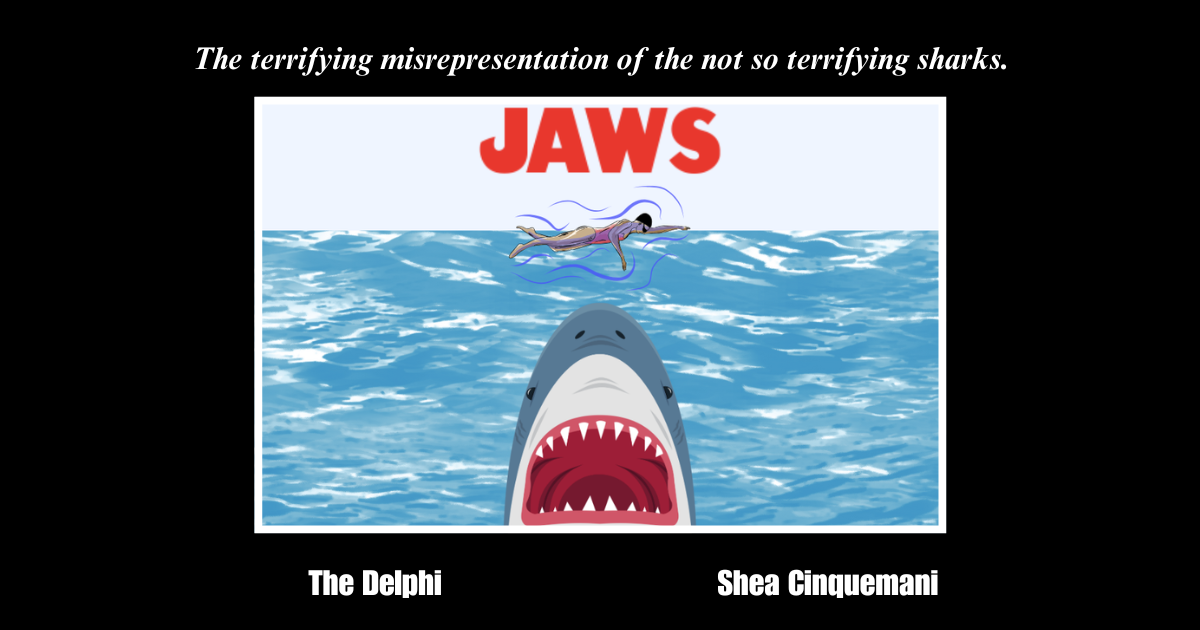











































This year marks the 50th anniversary of the beloved thriller, directed by Steven Spielberg, “Jaws.” The film itself grossed about 260.7 million dollars domestically and 476.5 million dollars worldwide during its first run in 1975. “Jaws” is famous for its portrayal of the blood-thirsty great white shark that haunts the summer resort town of Amity Island. Though, are sharks really just beasts who are out for human flesh?
“Jaws” is a timeless and influential film, not only for with how well it was made for its time, but also for its inspiration of a trend that would continue for years to come: sharks as the main antagonists in films.
The influence from “Jaws” led to sharks being portrayed as “man-eaters,” “violent beasts” and “ruthless killers.” This idea became widely popularized, inspiring more modern films like “47 Meters Down“ and “The Meg.”
Del Val’s English and Film & Literature teacher Michael Fortino is a self-proclaimed “Jaws” super fan, having first watched the movie when he was in elementary school.
“I was afraid to go into the water for a while,” Fortino said. “There are sharks out there that, you know, want to chomp me up.”
Fortino admits that his fears were specifically due to the film.
“It [‘Jaws’] might have been the catalyst for the idea that I am in an ocean that is giant and deep, and that I don’t know what’s out there,” Fortino said.
Before seeing the film, his ideas were different. Rather than fearing sharks, he thought the opposite.
“They [sharks] were cool because I was like a little kid going to aquariums. They were fun,” Fortino said.
Del Val class of 2020 alumna, Shea Cinquemani, is a marine biologist and shark enthusiast. Cinquemani is one of many shark fans to have watched the movie more than once, but her views were not swayed by fiction.
“I know for a lot of people it’s the first thing that pops into their minds when they think about sharks…. The fiction gets replaced with reality,” Cinquemani said.
With that, she explains how both Peter Benchley, the author of the original “Jaws” book, and Steven Spielberg both expressed their regrets and guilt for the negative impact the story brought about.

“Benchley admitted he regretted the negative impact his story had on how society perceived sharks and became a shark conservationist,” Cinquemani said.
With this misrepresentation of sharks comes misinterpretation.
As the fear of sharks continues to worsen, many people to this day also believe certain myths about sharks that only help to push negative views. Cinquemani does her part to help disprove and educate others. One of the most common misconceptions would be the belief that sharks are “blood-thirsty man-eaters.”
“There are certainly some more aggressive shark species out there, like the Bull Shark…but sharks aren’t malicious. Sharks, like all wild animals, work off instinct,” Cinquemani said. “Prey is prey. The animal kingdom doesn’t care about what and who, so long as biological needs are met. You can’t fault a wild animal for being a wild animal.”
This is only one example of the several misconceptions about sharks. Unfortunately, the media and Hollywood haven’t done sharks any favors when it comes to accurate representation. If someone were to look into how many shark-human interactions occurred in 2024 compared to how many people died or were injured on railroads and subways in the same year, one would find that one occurrence is significantly more common than the other: sharks are less deadly.
“A shark attack gets more viewers than a train incident, which is why they feel more common than they actually are,” Cinquemani said. “Look up how many people die of illness, disease, or food poisoning…deaths or injuries related to bee stings…hospitalizations because of car crashes, shootings or even something as inconspicuous as falling down the stairs. The numbers will shock you. The comparison to shark attacks, confirmed or otherwise, will shock you more.”
Cinquemani strongly believes that with enough effort and education, people can see sharks for what they really are.
“There’s hope. There’s always hope,” Cinquemani said. “So, it’s our jobs, mine as a scientist, yours a journalist or a reader, to foster those connections. Change those minds. Fix that narrative. Let’s save our sharks.”