




















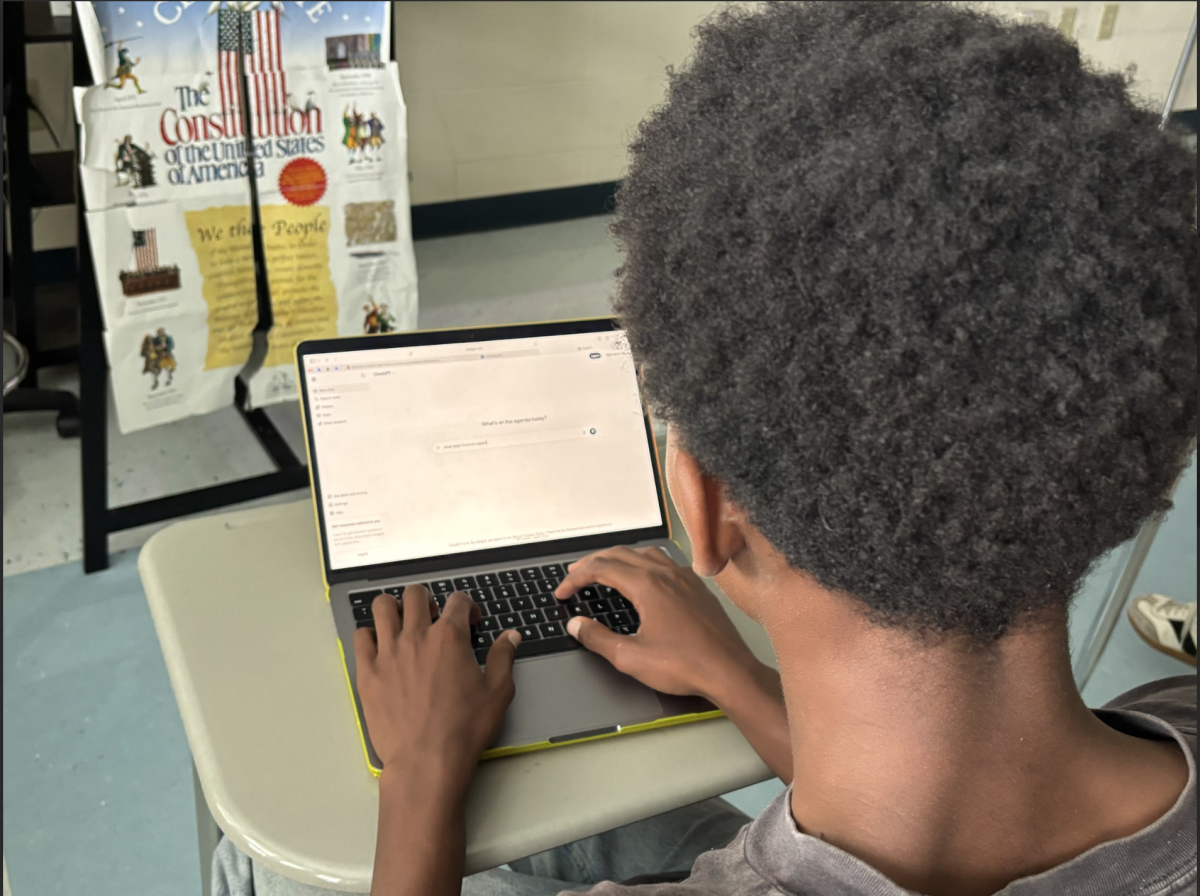




As the school year begins, conversations about proper use of artificial intelligence continue to rise.
The use of AI has increased since ChatGPT’s launch on Nov. 30, 2022. With this rise, it has begun debates about if it is ethical to be used in schools. With the general rise of AI usage, we have seen an upward trend of it being used by not just by students but by teachers as well.
According to a study from SQ Magazine, 42% of students, K-12 interacted with some sort of AI-based learning tool daily in 2025.
But what is AI?
James Madison University defines AI as, “the development of computer systems that can perform tasks typically requiring human intelligence. These tasks include reasoning, learning, problem-solving, perception, and language processing. AI systems can be rule based or learn from data, enabling the systems to adapt and potentially improve over time.”
The type of AI most commonly used is generative AI. JMU defines generative AI as, “a subset of artificial intelligence focused on creating new content, such as text, images, music, or videos, based on learned patterns from existing data, like large language models (LLMs). It uses techniques like deep learning and natural language processing (NLP) to generate outputs that resemble the training data, often producing creative and novel results.”
According to SQ Magazine, “87% of schools globally will now have integrated AI tools into at least one area of instruction or operations by 2025,” showing that most schools around the world are adapting to the rise of AI, incorporating it into their schools.
Del Val has also adapted to the rise of the use of AI, in some ways even specifically incorporating it into classes. Del Val business teacher Joseph Perricone is an example of embracing AI in educational settings.
“I usually don’t allow AI to be used in my classes, but then in certain classes, such as marketing or the entrepreneur class, where we need to get things done more efficiently and with the best outcomes, I encourage them to use AI,” Perricone said. “Case and point, we had to make a flyer for our entrepreneur class and I told a student to use AI and just how to communicate with Gemini, and I said, it will create a flyer. Within 30 minutes, the student had a flyer that was better than they expected, and they couldn’t believe that they actually accomplished something by using AI.”
Educators like Perricone prove that AI can have a positive effect on students’ learning and their environment. They can use it as a study tool, a tool to help correct grammar, a tool for brainstorming and more.
“I have used AI before to help me understand how to do a problem, usually in math or physics, that I was stuck on,” senior Maya Sliver said.
It can also help teachers with things such as creating lesson plans.
“For me as a teacher, personally, it’s really helped me get my Sunday’s back, to make lesson plans, to ask more critical thinking skills, deeper critical thinking skills, better critical thinking questions, with utilizing AI,” physical education teacher Matthew Hagy said.
However, for all the positives of AI, the technology also has its negative effects. AI has had a negative impact on student motivation and has caused a rise in cheating. It is also known to have hallucinations, creating fake information.
“It doesn’t actually give you straight facts, it just scans the internet and gives you multiple different answers,” junior Samatha Calabro said. “The worst part is no one double checks their answers. They just assume it’s correct.”
To combat the use of AI in negative ways, many schools have created academic integrity policies that mention AI-use in classes, Del Val included.
“Del Val’s current AI policy is that AI tools are open,” Supervisor of Curriculum Tara Civitillo said. “We do not block any. We want students and staff to learn to utilize AI, generative AI, appropriately and ethically.”
While AI certainly can help students and teachers, it has multiple downsides that can also harm education. Overall AI usage is common among students and teachers, leading to multiple positive and negative effects along the way, and it should not be something that is feared, but rather something people are taught how to use properly so it can be a useful tool for them.
“AI can be used in bad ways, yes, but it can also be a really helpful tool,” junior Kaitlyn Misar said. “So instead of people in charge of schools coming about it in a negative way, they should look at it in a different perspective, teach kids how to use it, ask for help and what not. The rise of AI in some instances is bad, but overall, it’s the people using and seeing it that way, not the AI itself.”
Is it proper use of Artificial Intelligence?
There was an error. Please try again.
6 Total Questions