

































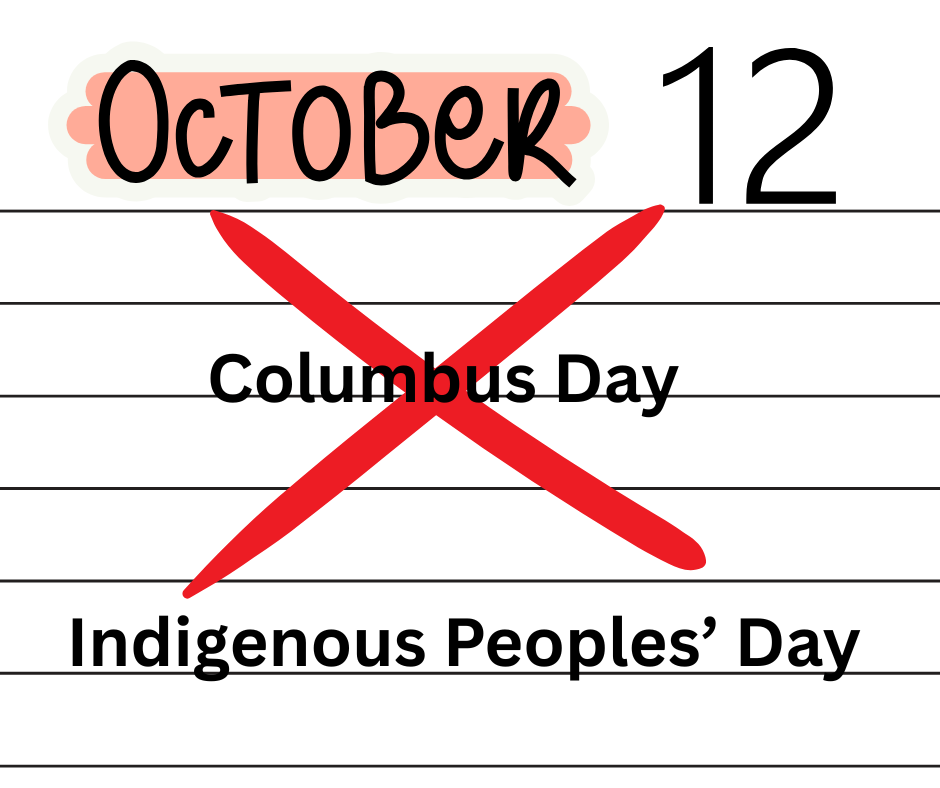









Over recent decades, the second Monday of October has become a major topic of debate and discussion among Americans. Citizens have questioned whether Columbus Day or Indigenous Peoples’ Day should be recognized as a national holiday, proposing a major controversy.
A better question would be: Should Americans celebrate someone who caused a detrimental pattern of violence and brutality on indigenous peoples, or celebrate Indigenous cultures and lives?
Columbus Day was initially celebrated in 1892, when US President Benjamin Harrison sought to honor the 400th anniversary of Columbus’ arrival to the Americas, supporting Italian-American heritage. Columbus Day was initially proposed to ease tensions between Italian-American immigrants and native-born Americans, following a violent lynching that created a major strain.
However, the holiday has indefinitely taken a turn away from that. Rather than celebrating Italian-American heritage, children and adults alike participate in parades and festivities focusing on Columbus’ voyage. Rather than learning about Italian American heritage, they often fixate on Columbus, and his accomplishments. However, they are only learning about one side of history, creating a dangerous lack of knowledge.
Although Columbus was credited with being the first European to successfully sail to the Americas, his cruelty and the atrocities he committed heavily outweigh the successes that we celebrate.
After entering the Americas, Columbus tortured and killed Native Americans, as well as decimating their societies and cultures. His treatment of Indigenous Peoples was unjust, and unnecessary; under his command, they were forced into laborious tasks, and subjected to both disease and violence.
Columbus and his men were directly responsible for the deaths of thousands of Native Americans, while indirectly causing close to 50 million deaths as a result of diseases brought to the Americas by Europeans.
On the other hand, supporters of Columbus Day argue that they are celebrating European exploration, and their discovery of the Americas rather than glorifying a ruthless conqueror.
However, even if supporters claim that the holiday commemorates the European discovery of the Americas, it still honors Columbus directly through the title.
Meanwhile, the people truly deserving recognition for their sacrifices are the Indigenous Peoples who suffered at the hands of Europeans.
Everyone knows the story of Columbus’ arrival in the Americas. However, most people lack a strong understanding of those who lived and flourished in the Americas prior to European colonization.
Giving Indigenous Peoples a holiday grants them recognition, and encourages Americans to celebrate and honor Native American culture, as well as becoming more educated in it.
Currently, the state of New Jersey celebrates Columbus Day rather than Indigenous Peoples Day. However, it is truly important to both our society, and our past as a nation to acknowledge and recognize those who are underrepresented, especially Indigenous Peoples.