


































































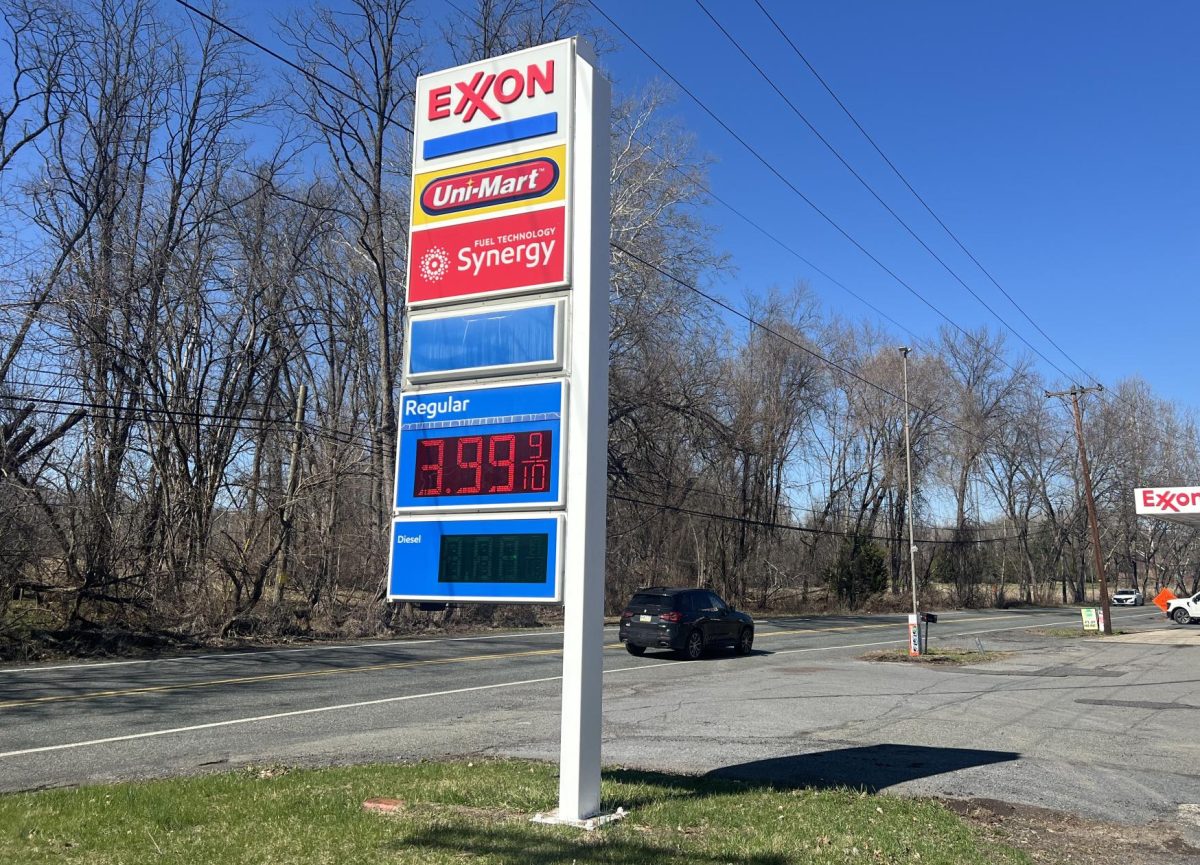
Marking a month since the U.S. and Iran’s conflict, gas prices have only continued to skyrocket, leaving Americans wondering when a resolution to the fighting will be found.
Beginning on Feb. 28, 2026, “Operation Epic Fury,” a full-scale military operation led by the U.S. and Israel in an attempt to disable Iran’s security equipment, military, and nuclear facilities, has been one of the first all-out missions of the ongoing “shadow war” between the two countries.
Prior to the conflict, crude oil prices sat at around $70 a barrel. Shortly after, they spiked to $120 and then fell to $100, where the price has remained constant for the past couple of weeks. Due to these increases in price, prices average around $3.96 per gallon for regular gas and $5.29 a gallon for diesel.
“I just want to buy things for college, and I can’t because I have to pay for gas,” senior Isabella Diem said.
Although Americans are seeing higher prices at the pump, these numbers are still not as high as they were in 2022 after Russia invaded Ukraine. During this time, averages were around $5 for a gallon of regular and $5.81 for a gallon of diesel.
“It was simply a supply issue with Russian oil,” AP U.S. Government teacher Ted Manner said. “This is talking about the strait [of Hormuz]. This is worse than the ‘73, ‘79 and ‘80 crises combined. This is much more impactful. You can’t have energy unless you have the strait.”
The closure of the Strait of Hormuz is a direct example of geopolitically-driven oil supply disruption. The strait is where the majority of oil produced in the Persian Gulf is exported.
“It all depends on the Strait [of Hormuz] and whether oil can go through it or not,” Manner said. “Iran will make that decision; it’s a supply issue like we’ve never seen before. There’s nothing that can be done unless Iran allows it.”
As of now, there is no sign that these prices will drop. In fact, the average cost of regular gas is expected to rise to $4 a gallon sometime this year.
This inflation is not exclusive only to gas prices. Limited supply of fossil fuels also impacts grocery and medical prices. In particular, the price of fertilizer is set to dramatically increase, leading to heightened grocery prices. Helium–which is used for medical imaging–is also expected to see a price hike.
Sustained high oil prices such as the one Americans are witnessing today lead to reduced consumer spending and increased transportation and manufacturing costs. The oil-producing nations benefit, but the major importer countries face the risk of recession.
“The money I’ve been making at my job hasn’t gone up and inflation has, so the money I’m making from my job is worthless,” senior Luke Cyphert said.
