
































Lines of people are stretching around stores hours before they open. Grown adults are trampling each other over children’s toys and cups. Simultaneously, thousands of people stalk websites, with some crashing and others selling out in seconds. Items marked up exponentially because companies know consumers will pay the price.
These might sound like Black Friday horror stories, but to some people, this is their reality.
Overconsumption has been around for generations, but attempting to go viral on TikTok and the convenience of online shopping has turned the problem into an everyday occurrence.
Professor Assistant at the University of Madeira Luísa Soares and faculty member at the University of Lisbon Sara Moniz said in their study, “Overconsumption and the Effects on Mental Health and Well-Being: A Review,” that “consumers who have the greatest tendency to carry out impulse purchases are those who are driven by hedonic desires or non-economic reasons, such as fun, social, or emotional satisfaction.”

The reasons people overconsume can be simplified into one simple idea: tying money to happiness.
“Over-consumerism is more the idea that we tie our happiness and our success to the amount stuff that we own,” accounting teacher Bessy Kapetanakis said. “Shopping online makes it easier to spend money, because you’re not spending actual cash, you’re just going online and putting in your credit card number. You don’t feel it in the moment, then you end up with credit card debt.”
In today’s culture, FOMO, or the fear of missing out, is a real drive for people when they decide to buy things or go places. The reason many people started buying items like NeeDohs, Labubus or Stanleys Cups was because they were popularized by influences on platforms like TikTok, Instagram and YouTube Shorts.
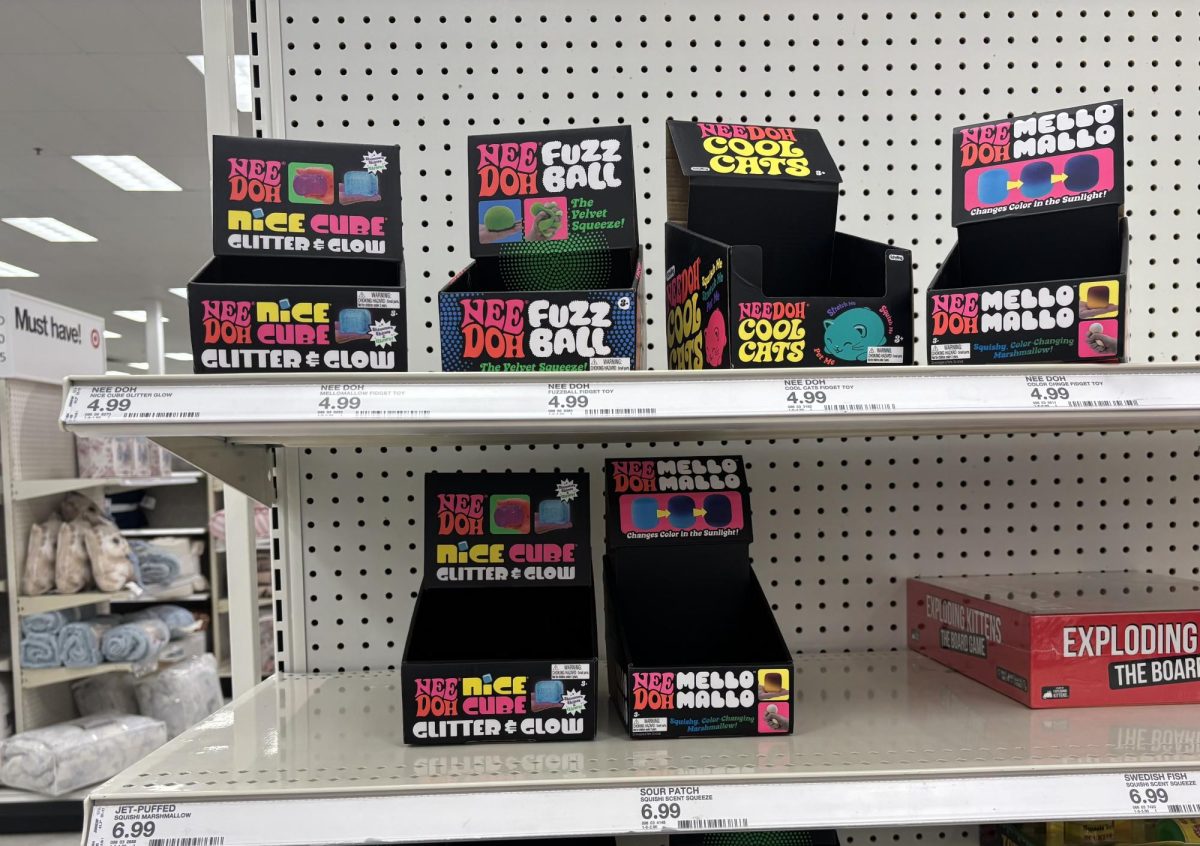
Due to the fast-paced nature of the internet, the trends change every month. Currently, Needohs have taken the internet by storm, but, before them, it was Labubus, and before that Stanley Cups.
NeeDohs specifically have had many people in a craze.
“[I heard about them] online, like TikTok,” Freshman Maryn English said. “A lot of people started to bring them to school, so I got one. It became a trend.”
It’s hard to find someone who doesn’t own an item like a Needoh.
“Almost everybody owns them,” Junior Kenzie Petsch said.
As trends fall out of fashion, many of these items are rendered useless, forgettable or seen as junk.
“After a while I didn’t really care for them [NeeDohs] anymore,” English said. “[They are] in my room on display. Every so often I use them, mainly when I’m bored. Though, I don’t trust people to hold them, so I keep them in my room.”
As a response to overconsumption, multiple trends with opposite missions have also gained popularity.
Initiatives like Project Pan, which encourages participants to use all of the products in makeup and beauty products before buying more, or the “Rule of 5,” which purchases in categories like fashion are limited to five a year, are ways people online are retaliating against overconsumption.
There are many ways, big and small, to make less impulsive purchases.
“Make lists of what you actually need,” Kapetanakis said. “If you find something you want but don’t need it, step away for 24 hours. And If you really want it after 24 hours, then go buy it. If not, it saves you from that impulse shopping.”
Ultimately, overconsumption has many purposes to those who participate: it’s a form of retail therapy, an adrenaline rush, the thrill of having a rare item, pride, a sense of accomplishment and even potentially online validation.
Companies have come up with systems designed to keep customers coming back. The likelihood of pulling a rare item from a blindbox, a type of sealed packaging that hides the design of an item until after it’s purchased, is small, which keeps consumers coming back for more, even when it harms them.
According to the American Psychological Association, participating in over-consumerism can bring both financial burden and mental health problems.
“When I first got [NeeDohs], it made me so happy, but then it didn’t make me happy anymore, and I was upset that I spent money on so many things that only brought me happiness for a short period of time,” English said.